1. Project Background and Purpose
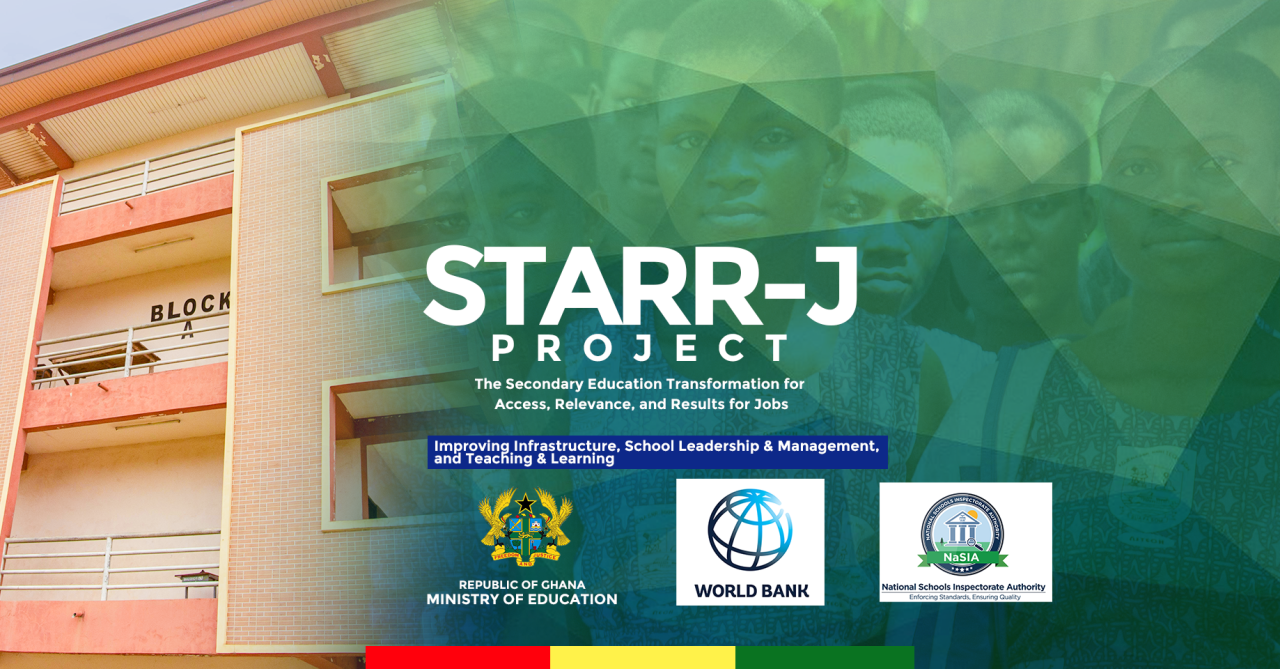
The Secondary Education Transformation for Access, Relevance, and Results for Jobs Project (STARR-J) Project is a major Government of Ghana initiative supported by the World Bank aimed at transforming secondary education through expanded access, improved quality, enhanced relevance, and better learning outcomes aligned with national development priorities and workforce demands.
The proposed project is designed as a four-year intervention spanning 2026 to 2030, with its investments and outcomes expected to generate long-term impact extending toward 2040 and beyond. The project therefore, will focus not only on addressing immediate infrastructure and access challenges, but also on creating sustainable and resilient secondary education systems capable of supporting future population growth, equitable access, and national human capital development over the long term.
A major component of the project is the rehabilitation, expansion, upgrading, and establishment of secondary education infrastructure to support increased enrolment and improve learning conditions across the country. This includes the construction of new classroom blocks, dormitories, laboratories, workshops, libraries, ICT centres, and other essential learning facilities; rehabilitation and upgrading of existing infrastructure to meet required standards; and targeted provision of essential furniture such as desks and beds to selected schools.
The project also prioritizes institutional upgrading, with the objective of improving infrastructure to transition twenty (20) schools from Grade B to Grade A, and thirty (30) schools from Grade C to Grade B, while strengthening the overall condition and operational capacity of the lowest one hundred and fifty (150) ranked Grade C schools.
In addition, the project proposes the construction of approximately nine (9) new secondary schools in districts and locations where access to secondary education remains limited or difficult. These interventions form part of the broader national objective of promoting equitable access and ensuring a fair geographical distribution of secondary education opportunities across the country, particularly in underserved, deprived and high-demand communities where students often travel long distances to access secondary education.
The investments under the project are intended to create safe, inclusive, resilient, technology-enabled, and well-resourced learning environments across Senior High Schools (SHS), Senior High Technical Schools (SHTS), TVET institutions, STEM schools, and SEND schools. Beyond physical infrastructure, the project seeks to improve teaching and learning quality, strengthen digital integration, enhance institutional capacity, and improve the relevance of secondary education to national development and labour market needs.
The project further supports the transition from the double-track system to a single-track system. While the double-track system helped absorb increased enrolment pressures following the expansion of access to secondary education, it reduced instructional time and placed significant strain on existing infrastructure and facilities. The STARR-J Project therefore seeks to ensure that schools have adequate infrastructure, capacity, facilities, learning resources, and support systems to accommodate students effectively within a single-track system while improving the quality, efficiency, and relevance of secondary education delivery.
Overall, the purpose of the STARR-J Project is to strengthen Ghana’s secondary education system through sustainable infrastructure investment, improved institutional performance, enhanced teaching and learning conditions, and equitable access to quality education, thereby preparing learners with the knowledge, skills, competencies, and opportunities required for further education, employment, and national development.
2. Project Objectives
Access: Expand equitable access to secondary education through the rehabilitation, expansion, upgrading, and establishment of safe, inclusive, resilient, and well-resourced learning environments capable of accommodating increased student enrolment across the country.
Relevance: Improve the quality and relevance of secondary education by strengthening STEM and TVET education, integrating digital learning and skills development, enhancing teaching and learning practices, and aligning education delivery with national development priorities and labour market demands.
Results for Jobs: Equip students with practical, relevant, and employable knowledge, skills, and competencies that prepare them for further education, entrepreneurship, technical and vocational pathways, and the world of work.
3. NaSIA’s Role
Under the Education Regulatory Bodies Act, 2020 (Act 1023), the National Schools Inspectorate Authority (NaSIA) is mandated to set standards, regulate, inspect, and provide quality assurance for pre-tertiary educational institutions to ensure quality, safety, accountability, and continuous improvement in education delivery.
Within the STARR- J Project, NaSIA’s role extends beyond routine inspection and regulatory oversight. Its responsibilities include standard setting, compliance monitoring, infrastructure and facilities assessment, validation of school capacity, performance monitoring, and continuous quality assurance across the full lifecycle of school infrastructure, teaching and learning, and institutional service delivery.
NaSIA conducts its inspections using its Inspection Evaluation Framework, which provides structured indicators and benchmarks for assessing schools across key domains including Infrastructure, Facilities, Environment, Safety, Leadership and Management, Assessment, Curriculum Planning and Implementation, and Institutional Performance. The framework is designed to evaluate compliance with national standards while also assessing the overall quality, functionality, inclusivity, and effectiveness of school operations and learning environments.
Through these inspections, NaSIA generates evidence-based findings, performance reports, and actionable recommendations that:
guide corrective actions and rehabilitation priorities
inform resource allocation and investment decisions
strengthen institutional accountability and performance improvement
support policy formulation and system-level decision-making
validate institutional readiness for student placement under the CSSPS and expanded enrolment
Based on the Inspection Evaluation Framework, schools are classified as:
Outstanding: Fully compliant, safe, well-maintained, highly functional, and strongly supportive of effective teaching and learning
Good: Largely compliant with minor gaps that do not significantly affect institutional performance or learning outcomes
Satisfactory: Meets minimum standards but with identified gaps requiring improvement and monitoring
Unsatisfactory: Below required standards, unsafe, poorly maintained, or not suitable for effective teaching and learning
This classification system supports evidence-based decisions relating to infrastructure upgrading, rehabilitation priorities, school improvement planning, institutional performance monitoring, readiness for student placement under the CSSPS, and the implementation of the single-track system within the national education system.
Under the Education Regulatory Bodies Act, 2020 (Act 1023), the National Schools Inspectorate Authority (NaSIA) is mandated to set standards, regulate, and inspect pre-tertiary institutions to ensure quality, safety, and accountability in education delivery.
4.0 Key Areas of Inspection and Validation
4.1. Facilities, Infrastructure, Environment, and Safety (Standards Assessment)
NaSIA assesses the extent to which schools comply with defined national standards for safe, functional, and sustainable learning environments. The focus goes beyond the mere availability of infrastructure to include quality, usability, functionality, and adherence to approved benchmarks. Across all components, emphasis is placed on standards compliance, functionality, and preventive maintenance to ensure that infrastructure remains fit for purpose over time.
4.1.1 Facilities and Infrastructure
NaSIA evaluates classrooms, all types of furniture, laboratories, workshops, libraries, ICT laboratories, boarding facilities, and staff accommodation. The assessment considers adequacy, physical condition, functionality, and alignment with standards required to support effective teaching and learning.
4.1.2 Specialised Learning Spaces
STEM laboratories, TVET workshops, and SEND-supportive facilities are assessed to determine whether they meet standards for practical instruction, inclusivity, accessibility, and safety.
4.1.3 School Environment
The overall school environment is reviewed in terms of cleanliness, organisation, drainage systems, waste management practices, and safe circulation within the school compound, with the aim of ensuring a healthy and structured learning environment.
4.1.4 Safety
NaSIA evaluates the structural integrity of buildings, fire safety systems, emergency preparedness, security arrangements, and overall risk management practices across schools, based on the availability of periodic expert evaluations and reports.
4.1.5 Health and Hygiene (WASH)
Water, sanitation, and hygiene facilities are assessed to ensure compliance with minimum health and safety standards, including access to safe water and adequate and functional sanitation systems.
4.2. Performance Monitoring
In addition to infrastructure and enrolment capacity, the STARR-J Project places strong emphasis on what is delivered within improved learning environments. NaSIA therefore integrates performance monitoring into its inspection framework to ensure that investments translate into strengthened teaching practices, improved learning quality, and better student outcomes.
This component examines both the quality of teaching and learning processes and the extent to which secondary education remains relevant to national development priorities.
4.2.1. Teaching and Learning Quality
This area focuses on evidence drawn from institutional records, implementation reports, and classroom-level practices to determine how effectively schools are delivering instruction and supporting learning.
Teacher Professional Development and PLCs: Review of records and reports on Professional Learning Communities (PLCs), including their functionality, frequency of engagement, and impact on instructional improvement and peer collaboration.
Digital Learning Tools and Resources: Assessment of the distribution, access, and utilisation of student tablets, as well as the integration of digital learning platforms such as iBox and iCampus into classroom instruction and independent learning.
4.2.2. Operational Performance Indicators
This dimension focuses on leadership capacity and institutional effectiveness in managing reforms and sustaining instructional improvement.
Leadership Capacity Building: Assessment of targeted training programmes for school leadership (headteachers and assistant heads), focusing on administrative leadership, financial management, and instructional leadership to strengthen school governance and supervision of teaching and learning.
Student Transcript Portal (STP): Monitoring the implementation and effective use of digital academic records systems for tracking and reporting learner performance.
Professional Learning Communities (PLCs): Monitoring of teacher collaboration structures, including functionality, participation, and alignment with school improvement objectives.
Attendance Monitoring: Tracking of teacher and student attendance patterns to ensure consistency and continuity in instructional delivery.
Utilisation of ICT Resources: Evaluation of the extent to which ICT infrastructure and digital investments are actively and effectively integrated into teaching, learning, and school management processes.
4.3 Validation of School Capacity
As part of the broader inspection framework and in support of the Computerised School Selection and Placement System (CSSPS), NaSIA undertakes structured validation of school capacity.
This is not conducted as a standalone activity but is fully integrated into the inspection process. It generates evidence-based reports that link available infrastructure and resources to student placement decisions.
The purpose is to ensure that student placement accurately reflects actual school capacity, thereby reducing overcrowding and safeguarding teaching and learning conditions, particularly within the context of the transition to a single-track system.
NaSIA assesses:
Classroom capacity and actual seating availability
Dormitory capacity and boarding accommodation limits
Programme-specific capacity across SHS, SHTS, TVET, and STEM pathways
Availability and functionality of laboratories, workshops, libraries, and ICT facilities
Overall institutional readiness for full enrolment
This process strengthens evidence-based planning and decision-making by the Ministry of Education and the CSSPS Secretariat.
5. Conclusion
The STARR-J Project is a strategic national reform initiative aimed at expanding access, improving quality, and strengthening the relevance of secondary education in Ghana.
The achievement of its objectives is dependent not only on the expansion of physical infrastructure but also on ensuring that schools comply with established standards, operate within verified capacity limits, and deliver quality and relevant education outcomes.
In line with its statutory mandate under Act 1023, NaSIA provides regulatory oversight through the development and enforcement of standards, structured inspections using its Evaluation Framework, generation of evidence-based findings and recommendations, validation of school capacity, and monitoring of system performance indicators.
Through these functions, NaSIA ensures that investments under the STARR-J Project are effectively translated into safe, functional, well-maintained, and inclusive learning environments that support effective teaching and learning, and enhance learners’ preparedness for further education, skills development, and employment.
Click here to download a project appraisal document